








A payroll engine can calculate salaries for 40,000 employees, apply hundreds of tax and entitlement rules, generate bank files, update the general ledger, and move millions of dollars every month with almost no human involvement. Now, consider a much smaller problem. An invoice arrives $93 above its purchase order. The arithmetic takes milliseconds. What resists automation is everything around the number. Was freight added legitimately? Was there a partial shipment? Did the vendor apply an outdated price? Is the purchase order itself wrong? Is there an email somewhere approving an exception?
Disclaimer: This article discusses architectural and operational decisions, including autonomy over financial transactions such as payroll and refunds, that can carry real business, legal, and compliance consequences. It is general educational content, not engineering, legal, financial, or compliance advice. Specific claims attributed to Anthropic, OpenAI, Microsoft, and METR reflect publicly stated positions or published research as of early-to-mid 2026 and should be independently verified before you rely on them, since vendor products and benchmarks change frequently. Before granting an AI agent authority over money movement, customer data, or irreversible actions, consult your own engineering, security, and compliance teams.
Payroll is the more complicated process by any engineering measure, yet the invoice discrepancy is the one that may intuitively need an AI agent. Understanding "why" requires a better frame than the familiar line about "automation following rules while agents reason."
This article builds that frame by showing how agent architecture has changed over the past two years, which decisions deserve runtime reasoning, how much authority an agent should have, and how to design systems that combine both safely.
What Is The Difference Between AI Agents and Automation?
The difference comes down to when decisions get made. Automation encodes decisions before execution begins. An agent leaves some decisions unresolved until runtime and lets the model work them out while the task is running. Everything else, including the way the two increasingly share the same infrastructure, follows from that distinction.
A traditional workflow settles its important decisions at design time. If the invoice amount is under $5,000, route it to Manager A. If the customer has been subscribed for fewer than 30 days, allow the cancellation. If a deployment health check fails three times, restore the previous version. The workflow's designer has already decided what each condition means and what happens next.
An agent receives a goal instead. For instance, "investigate why this invoice cannot be paid, and resolve everything you safely can." At design time, nobody knows whether the agent will need the purchase order, the contract, the receiving record, vendor correspondence, historical invoices, or all five. The model discovers the useful path as it works.
Microsoft's current architecture guidance describes exactly these two patterns coexisting inside the same durable application. In a deterministic workflow, code defines the sequence and the model performs work inside individual steps. In an agent-directed loop, the model decides which tools to call, in what order, and when the task is complete. Both patterns can share the same checkpointing, retries, state management, and human-approval infrastructure.
That gives architects a more useful question than "agent or workflow." Which decisions should be settled when we design the software, and which are worth postponing until runtime?
Modern systems increasingly answer "both," in layers. An agent can sit inside a workflow as a single judgment step. A workflow can be exposed as a capability an agent invokes. A durable runtime can sit underneath the entire agent loop. Even n8n illustrates this convergence. Its MCP Server Trigger earlier let AI clients execute existing workflows. However, its newer instance-level MCP access gives those clients search, create, edit, and test workflows through the same interface. Automation still does the heavy lifting; it now does it from a different position in the stack.
If you are still mapping the journey from simple conversational bots to goal-directed systems, our post on the shift from chatbots to agentic AI covers what actually changes between the two.
What Does a Modern Agent Architecture Look Like?
A modern agent is a model operating inside a managed environment involving a workspace, a filesystem, a shell, tools, persistent state, reusable skills, security boundaries, and evaluation infrastructure. The model is one component in a much larger system, and most production design effort now goes into the environment around it.
Two years ago, the anatomy of an agent fit on a whiteboard with "prompt, model call, tool call, observation, repeat." That loop still exists, but it no longer describes the most capable systems. OpenAI's sandbox agents, for example, give a model shell access, file editing, skill discovery, memory, and context compaction inside a controlled execution environment.
Anthropic arrived at a strikingly similar decomposition from the opposite direction. Its Managed Agents architecture splits an agent into three interfaces, namely the session, a durable event log of everything that happened; the harness, the loop that invokes the model and routes actions; and the sandbox, the isolated environment where generated code runs. Each can fail, scale, and evolve independently of the others.
This is why vocabulary like harness, runtime, sandbox, skills, compaction, and context engineering suddenly appears in every architecture discussion. These layers solve problems that barely existed when an agent made five API calls and finished in 45 seconds.
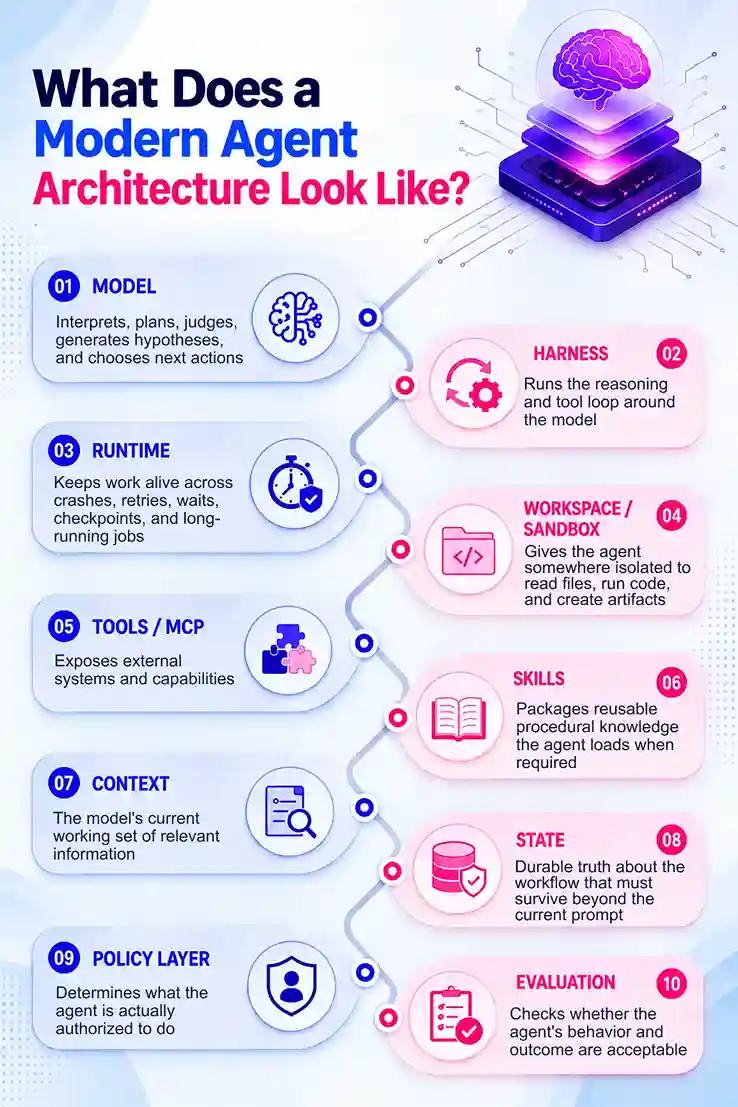
| Layer | What it actually does |
|---|---|
| Model | Interprets, plans, judges, generates hypotheses, and chooses next actions |
| Harness | Runs the reasoning and tool loop around the model |
| Runtime | Keeps work alive across crashes, retries, waits, checkpoints, and long-running jobs |
| Workspace / Sandbox | Gives the agent somewhere isolated to read files, run code, and create artifacts |
| Tools / MCP | Exposes external systems and capabilities |
| Skills | Packages reusable procedural knowledge the agent loads when required |
| Context | The model's current working set of relevant information |
| State | Durable truth about the workflow that must survive beyond the current prompt |
| Policy layer | Determines what the agent is actually authorized to do |
| Evaluation | Checks whether the agent's behavior and outcome are acceptable |
None of this is new computer science. Containers, workflow engines, permissions, event logs, and procedural runbooks all predate language models. What changed is their importance around a model that can now work for hours, manipulate an environment, discover tools, write code, revise its own plans, and keep going after intermediate failures. The agent has effectively acquired an operating environment, and engineering that environment has become the discipline.
For a component-by-component breakdown of how these pieces behave once real traffic hits them.
Also read Components of an Agentic AI System: What Each Component Actually Does in ProductionFrom Designing Paths To Designing Environments
Traditional automation engineering asks what path the software should follow. Agent engineering asks what environment the model should be allowed to operate inside. That is a much larger shift than adding another AI node to a flowchart.
Consider a coding agent. You could expose 200 explicit functions like read_file(), edit_file(), search(), run_test(), install_package(), inspect_history(), and so on. Or you can provide a constrained computer with a filesystem, a shell, the repository, permissions, instructions, and a test suite, and let the model work out which sequence of operations is useful.
Anthropic's long-running agent work increasingly follows the second model, giving agents files, Git history, progress artifacts, and persistent environmental signals so that a fresh context can reconstruct what earlier sessions completed. Context compaction alone generally cannot sustain reliable long-running work. The environment has to carry the memory of the project as such.
Skills extend the same idea. Anthropic's Agent Skills package instructions, scripts, and resources into folders the agent discovers and loads on demand, so the system prompt no longer has to carry every standard operating procedure at all times. This marks a conceptual shift. Workflow designers enumerate paths, while agent engineers design bounded possibility spaces. Bounded is the operative word. A useful environment is constrained, permissioned, and observable.
The context layer deserves special mention, because filling it well is a retrieval problem in its own right. We covered the practical side in How to Give AI Agents Reliable Company Context in a RAG System.
When Should You Use an AI Agent Instead of a Deterministic Workflow?
Use an agent when the correct next step cannot be determined before execution starts, because the input is ambiguous, the evidence is incomplete or conflicting, or the path depends on what the system discovers along the way. If structured state and maintainable rules already determine what happens next, conventional software will do the job cheaper, faster, and more predictably.
Complexity is the wrong trigger, and it misleads enterprise teams constantly. A million-step process can still be fully deterministic. For instance, global payroll is complicated. ETL platforms are complicated. Payment settlement is complicated. Cloud provisioning is complicated. Yet, in each case the valid state transitions are known and expressible in code, so bolting model judgment on top adds cost and variance while contributing very little.
Now, let's return to the invoice. The correct answer may hinge on a vendor email that reads:
Resolving that sentence requires an investigation. Who is Jonathan? Was he authorized? Where is the April review documented? Does "approved" cover this purchase order? Does the contract permit freight charges at all? Was the revised rate ever entered into the procurement system? Each answer determines the next question. The path depends on what the system discovers, which is a categorically different problem from workflow complexity.
OpenAI's guidance for builders points in the same direction. Agents earn their keep where decisions are nuanced, rules are difficult to maintain, or the work depends heavily on unstructured data, and it explicitly notes that a deterministic solution is often sufficient otherwise.
A practical first rule follows. If the correct next operation can be reliably determined from known state using code you are willing to maintain, write the code. Paying a model to probabilistically rediscover a decision you have already made adds cost and risk while contributing nothing.
How Do You Decide Where Reasoning Earns Its Place?
Ambiguity tells you whether reasoning might add value, but it is only the first variable. A production-grade decision framework weighs four such variables, namely ambiguity, verifiability, consequence, and reversibility.
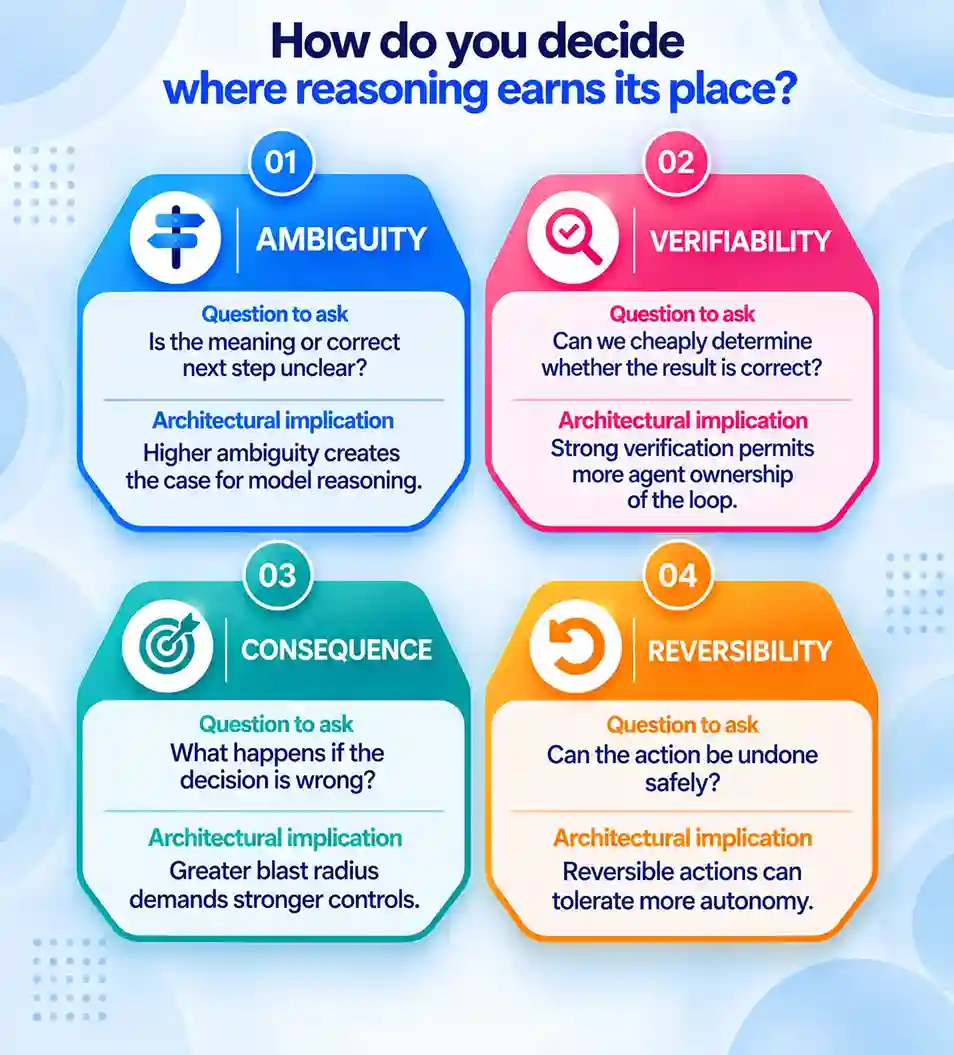
| Variable | Question to ask | Architectural implication |
|---|---|---|
| Ambiguity | Is the meaning or correct next step unclear? | Higher ambiguity creates the case for model reasoning |
| Verifiability | Can we cheaply determine whether the result is correct? | Strong verification permits more agent ownership of the loop |
| Consequence | What happens if the decision is wrong? | Greater blast radius demands stronger controls |
| Reversibility | Can the action be undone safely? | Reversible actions can tolerate more autonomy |
If There's Low Ambiguity, Automate It.
Some examples include tax calculations, known approval thresholds, schema validation, permission checks, scheduled reports, deterministic reconciliation rules, and exact financial arithmetic. Running a language model over these is a needless reasoning theater. The model performs the appearance of judgment on a decision that was never in doubt, and invoices you for that privilege.
If There's High Ambiguity and High Verifiability, That's Strong Agent Territory.
This is why coding became the breakout agent domain. The model rarely knows the path in advance, but the environment grades every attempt. The compiler succeeds or fails. The test passes or fails. The linter flags the error. Git shows exactly what changed. The agent can reason, act, observe, revise, and try again, and each cycle stays cheap because truth is cheap.
If There's High Ambiguity And Weak Verifiability, Then Reason, But Cap The Authority.
Some examples in context include interpreting an unusual contract, assessing reputation risk, reviewing a sensitive employee complaint, forming a strategic recommendation, and investigating suspected fraud. A model can be enormously useful in all of these, yet no test suite can certify the answer. The right shape here is an agent that investigates, synthesizes, challenges assumptions, and recommends, while a person or a policy layer owns the final commitment.
Why Are Coding Agents So Effective, And What Can Enterprises Learn From Them?
Coding combines high path uncertainty with unusually strong, objective verification. Every action produces environmental feedback the agent can use to correct its next step, and that feedback loop is exactly what most enterprise domains lack.
Coding agents are frequently cited as proof that broad enterprise autonomy is just around the corner. That reading skips the variable doing most of the work. Coding is unusually friendly to agents because the environment is rich in objective feedback, and the best agent teams treat that feedback as infrastructure.
In one of the Anthropic experiments in early-2026, 16 parallel Claude agents spent nearly 2,000 Claude Code sessions and around $20,000 in API costs producing a 100,000-line C compiler capable of building the Linux kernel on three architectures. The output made the headlines. The instructive part was the harness. Researcher Nicholas Carlini described how tests written to keep agents on track without human oversight, including a GCC-based oracle that localized faults so agents could work in parallel, carried the project. Autonomy scaled because verification scaled first.
Parallel agents are also a deliberate design choice rather than a default. If you are weighing one capable agent against a team of them, our single agent vs multi-agent decision framework walks through the trade-offs.
That ordering generalizes into a design principle. Before increasing autonomy, we must manufacture verifiability.
If an agent reviews invoices, it helps define schemas and deterministic tolerance checks. If it conducts research, we must require citation validation. If it repairs infrastructure, provide health checks and dry-run environments. If it generates database migrations, validate the schema and test against a clone. If it changes code, put every change behind CI and a pull request. The better the environment can answer “did that actually work?”, the less expensive human supervision becomes, and the more of the loop you can safely hand over.
Also read RAG in Production: Chunking, Reranking, and Freshness DecisionsHow Much Autonomy Should an AI Agent Have?
Reasoning depth and granted authority are separate design decisions, and mature architectures keep them in separate components. A system may perform sophisticated reasoning and be permitted to change nothing; another may move millions of dollars while doing no reasoning at all.
A payroll platform autonomously transfers millions every month while performing almost no model reasoning. A legal AI can conduct sophisticated analysis of 200 pages of contracts while being authorized to change absolutely nothing.
OpenAI recommends explicit human intervention for sensitive, irreversible, or high-stakes actions such as large refunds and payments, regardless of how capably the agent reasoned about the task. That separation deserves to be structural.
Suppose the model concludes that a customer appears eligible for a $7,450 refund because clauses A, B, and C apply. That conclusion is a reasoning output. A deterministic policy layer should still ask the authority questions.
Note: The mentioned example is illustrative. Actual refund authorization thresholds and approval requirements should be set by your finance and compliance teams, not inferred from this article.
Is this agent permitted to request refunds at all? Is this user authorized on this account? Does $7,450 exceed the autonomous limit? Does the transaction require dual approval? Has an identical refund already been submitted? The model decides what it believes should happen. Whether the system is allowed to make it happen belongs to a different component, and that component should be boring, testable, and deterministic.
Also read 9 zero-trust security essentials for connecting AI agents to your CRMWhy Do Capable Agents Demand More Deterministic Infrastructure?
Because runtime reasoning creates failure modes that only deterministic systems can absorb. The more judgment you allow at the top of the stack, the more checkpointing, retries, idempotency, and state management you need underneath it.
For instance, suppose an agent is three hours into a supplier-dispute investigation. The process can crash. An API can time out. The vendor system can become unavailable. The agent may need to wait eight hours for a human approver. A tool call may have succeeded even though its response timed out. The model may need to resume tomorrow morning. A financial action must never execute twice. Every one of these is a distributed-systems problem, and none of them gets solved by a smarter model.
Architectures like Microsoft's Durable Task make this separation explicit. Model calls and tool executions can remain nondeterministic activities while the surrounding runtime provides checkpointing, retries, persistent state, human-interaction waits, and failure recovery. Microsoft's guidance for long-running hosted agents goes further, pointing teams to workflow engines for fan-out and fan-in coordination, durable timers, and child workflows, to application storage for large external state, and to downstream idempotency for side effects. Nobody seriously expects the agent runtime to absorb those jobs on its own.
State is the hardest of these problems to retrofit. If you are designing for agents that run for hours or days, our guide on managing memory and state for long-running agentic AI workflows goes deeper.
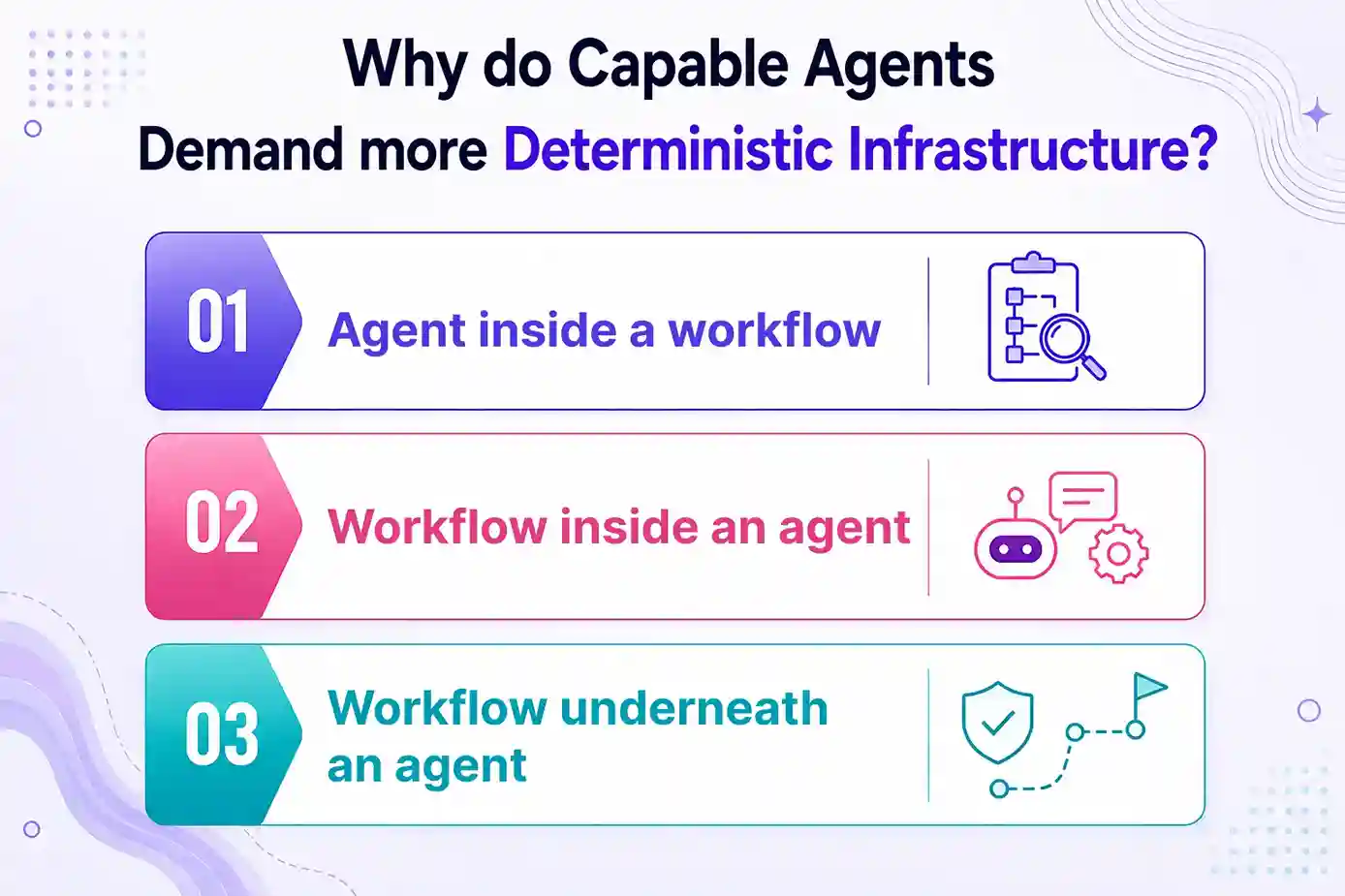
Three composition patterns now show up repeatedly in production:
- Agent inside a workflow
- The process is known, but one step requires judgment.
- Workflow inside an agent
- The agent decides that a known business procedure should run, then invokes it as a capability.
- Workflow underneath an agent
- The model controls portions of the path while durable infrastructure keeps the overall execution recoverable.
In practice, the useful design question is which layer owns which decision. Teams that frame it as a contest between agents and automation end up answering the wrong question entirely. We've unpacked that control model layer by layer in The Orchestrator Explained: How AI Agent Decisions Are Controlled.
What Does a Production-Grade Agent Architecture Look Like?
Across vendors and internal platforms, a common pattern is that reasoning operates as one stage inside a deterministic envelope.
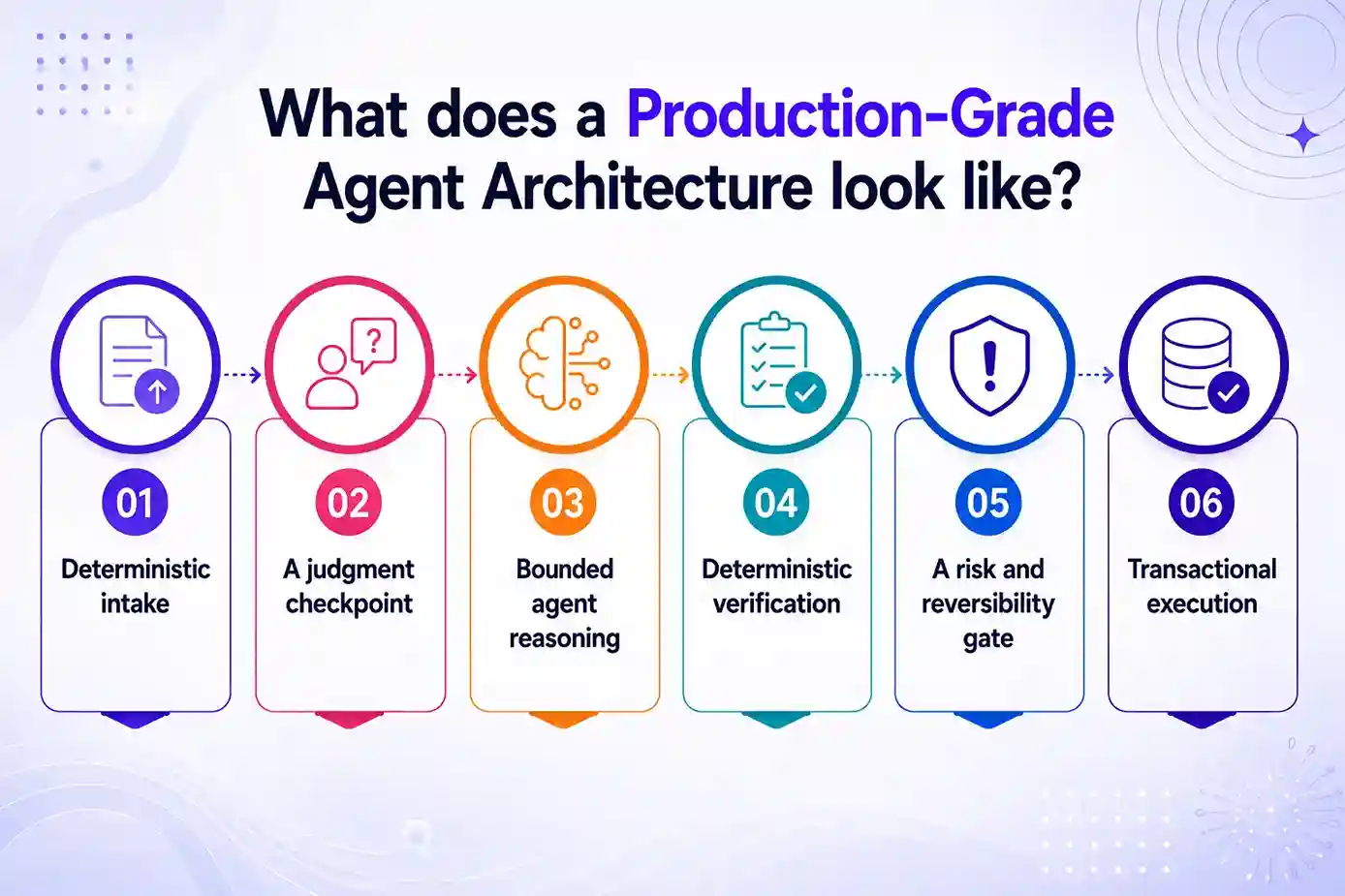
A typical production flow has six stages.
-
Deterministic Intake
This includes authenticating the user, normalizing the request, validating basic schemas, retrieving permitted context, and applying obvious hard rules.
-
A Judgment Checkpoint
If the next step is already known, the process stays in the workflow. If the situation is ambiguous, the process may be delegated to an agent.
-
Bounded Agent Reasoning
The model investigates, gathers evidence, uses approved tools, revises its plan, and produces a structured proposal.
-
Deterministic Verification
Validate schemas, calculations, evidence requirements, policies, budgets, permissions, and action limits.
-
A Risk and Reversibility Gate
Low-risk, easily reversed actions should generally execute automatically. High-consequence or hard-to-reverse actions must require approval.
-
Transactional Execution
Conventional software should own the actual commit such as idempotency, retries, state transition, and the audit record.
The model occupies just one of six stages. This shape has a practical advantage that matters to anyone with an existing automation estate. It upgrades the automation you already have without forcing a rebuild.
Here, accounts payable is the clearest example. The deterministic system keeps performing ingestion, duplicate checks, exact arithmetic, three-way matching, tolerance limits, and ERP posting. Only the exception path becomes agentic. The agent investigates why an invoice failed the match and returns a documented recommendation. That is a far safer use of intelligence than rebuilding the accounts payable platform around an autonomous agent, and this is where several teams we've worked with have reported measurable returns.
Does MCP Replace Workflow Orchestration?
No. MCP handles tool discovery and connectivity; it does not provide durable state, retries, or approval gates.
It standardizes how agents discover and interact with tools and data. Durable state, transaction semantics, retries, authorization, idempotency, and approval gates still have to come from somewhere, and orchestration infrastructure remains the usual source.
MCP and code execution have genuinely changed the tool layer. Early tool-using agents loaded dozens or hundreds of API definitions into context, called tools one at a time, and pushed every intermediate result back through the model.
But now, Anthropic has demonstrated an alternative. We can present capabilities as files the agent can inspect, let it load only the interfaces it needs, have it write code that calls those interfaces, and keep intermediate results inside the execution environment so only relevant output ever reaches the model. In Anthropic's example, token usage fell from roughly 150,000 to 2,000, a 98.7% reduction, which helps explain why shells, sandboxes, and filesystems are becoming the standard agent infrastructure.
Connectivity and authority, however, are separate concerns. MCP can make a capability discoverable. A sandbox can let the agent combine capabilities flexibly. Neither one decides whether a financial mutation is authorized. As integration gets easier, policy boundaries carry more weight, and the systems that enforce those boundaries (workflow engines, policy layers, transaction managers, etc.) become more load-bearing with every capability you connect.
What Does Runtime Reasoning Actually Cost?
Token spend is the most visible line item and rarely the largest. Every probabilistic decision expands what you might call the reasoning surface area of the system, and the bill arrives in several currencies beyond tokens.
A deterministic comparison takes microseconds; an agent may need several inference and tool cycles to reach the same point, so latency climbs. The same situation can produce different trajectories on different runs, so outputs vary. Unit tests stop being sufficient, and teams need scenario suites, trajectory analysis, repeated runs, and outcome evaluation. Debugging now requires reconstructing the model's context, chosen tools, intermediate state, and downstream actions.
A model consuming untrusted input while selecting tools opens attack paths that traditional workflow code never had. And once an agent works for hours, the system needs state persistence, checkpoints, resumability, context management, and compensation logic.
None of this makes reasoning too expensive. It means reasoning should earn its place. If business rules have metastasized into 15,000 fragile branches, model judgment can cost far less than maintaining them. If the work requires semantic interpretation of messy evidence, deterministic software may never solve it adequately. The discipline is to spend reasoning where it buys something software cannot provide, and to stop spending it on decisions software already knows how to make.
How fast is the delegation frontier moving?
Quickly, and unevenly. Capability, reliability, deployability, and authority are four separate frontiers, and they do not move together.
METR tracks model capability through task-completion time horizons, the task duration at which an agent succeeds half the time. Its April 2026 update put the frontier 50% time horizon at roughly 17 hours on its software-heavy benchmark suite, with the caveat that measurements above 16 hours strain the current task suite. That is remarkable progress, and it is easy to misread. A 50% time horizon describes what a model can do half the time; it was never designed as a delegation threshold. METR itself notes that reliability-critical or poorly verifiable tasks may require success rates above 98% before automation makes economic sense.
Four frontiers therefore matter. Capability for can the model do it at all. Reliability for how often does it succeed? Deployability for can you operate it economically and recover when it fails? Authority for should it be permitted to execute the consequence?
A model may become capable of reviewing a financial investigation years before an enterprise should grant it unilateral authority to freeze an account. As capability improves, some decisions that once required explicit software or human judgment will move into runtime reasoning. They should cross that boundary only when verification, economics, security, and governance cross it too.
How Do You Decide What to Agentify?
Map the process without AI first. Then interrogate every meaningful decision with four questions.
Is the correct decision already knowable from structured state and maintainable rules? If so, keep it deterministic.
If the decision resists rules, what uncertainty needs resolving: ambiguous language, incomplete evidence, diagnosis, investigation, planning, or changing environmental state?
How will the system know the reasoning was correct? Build tests, schemas, reconciliation checks, evidence requirements, or simulations wherever possible.
What is the maximum safe authority for this decision? Weigh blast radius and reversibility independently of reasoning quality.
This framing changes the implementation conversation. For accounts payable, the productive question is where the process currently stalls because rules cannot economically resolve the exception. For cloud infrastructure, it is which decisions require interpretation and which changes can be verified and safely rolled back. For customer support, it is which parts require understanding the customer's situation and which account actions should remain deterministic capabilities.
Questions like these produce architectures. Asking "can we build an agent for X?" mostly produces demos.
The Bottom Line
Automation is gaining a reasoning layer. The emerging architecture assigns three distinct responsibilities: the model decides what must be discovered at runtime, the workflow guarantees what must happen reliably, and the policy and transaction layers decide what is allowed and record what actually happened. As models improve, they will own more of the path. Harnesses will simplify, and some of today’s orchestration scaffolding will become unnecessary.
The underlying principle survives all of that change: encode what you know, delegate what must be discovered, verify what can be verified, and gate what can hurt you. The most mature agent system will rarely be the one with the most reasoning. More often, it will be the one that knows exactly where reasoning stops adding value.
Frequently Asked Questions
No. Increasingly, they are being composed with it. Architectures like Microsoft's Durable Task explicitly support both deterministic workflows and model-directed agent loops in the same programming model.
Use runtime model reasoning when the correct path cannot be adequately determined before execution. For example, when inputs are ambiguous, evidence is incomplete or conflicting, the system must investigate dynamically, or deterministic rules have become prohibitively difficult to maintain. If the next action is already reliably knowable from a structured state, conventional software is usually preferable.
An agent harness is the software around the model that manages its working loop. It constructs context, calls the model, interprets actions, routes tool use, enforces limits, manages handoffs, and coordinates with its execution environment.
No. MCP standardizes how agents discover and interact with tools and data. It does not replace durable state, transaction semantics, retries, authorization, idempotency, approval gates, or business-process control. Execution on it still depends on orchestration.